 Sedona City Guide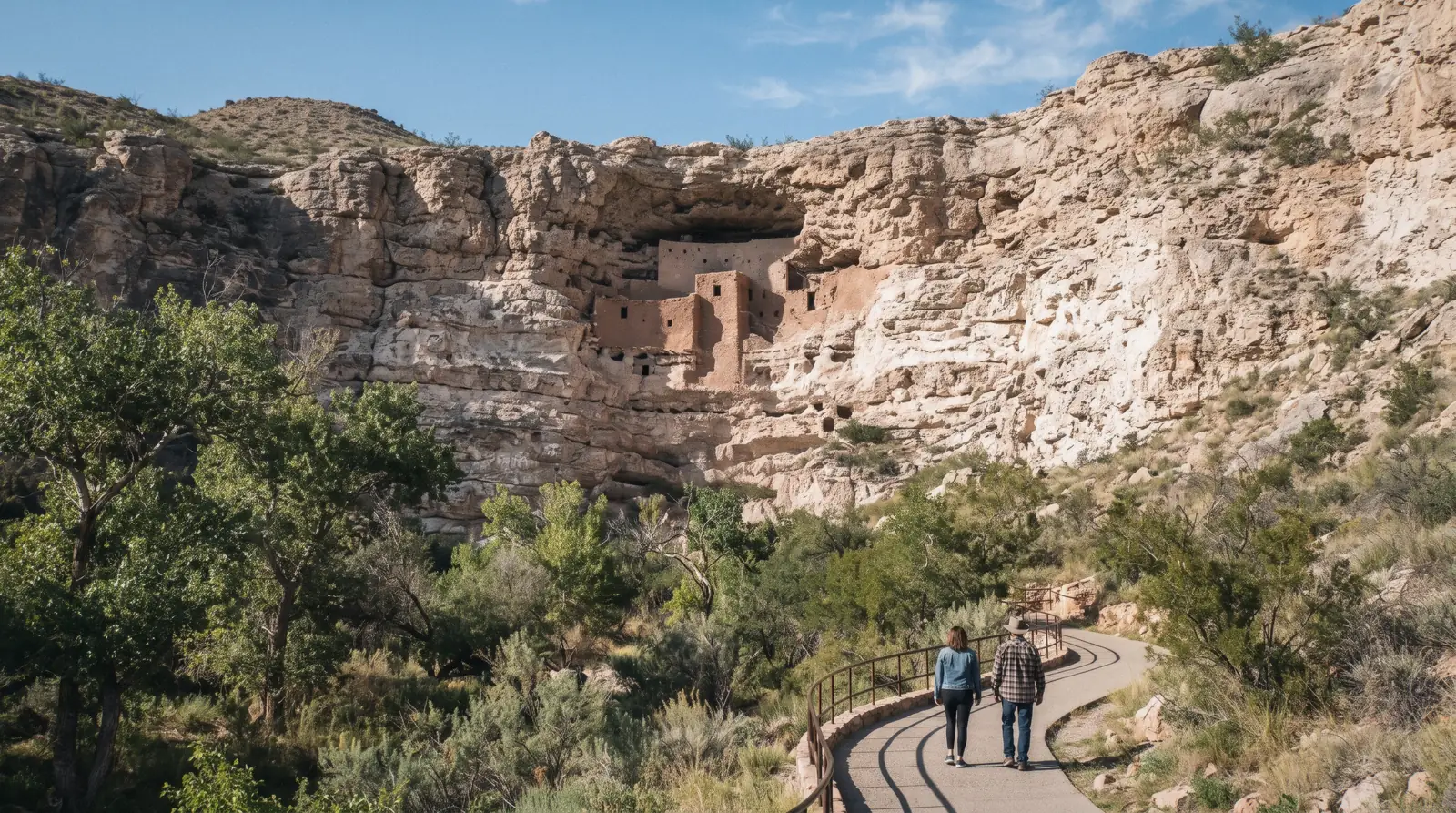
Montezuma Castle National Monument
Montezuma Castle is a five-story Sinagua cliff dwelling built into a limestone cliff above Beaver Creek, a short drive off I-17 south of Sedona. Neither Aztec nor a castle, it's one of the best-preserved cliff dwellings in North America, and this page covers the fee (which also gets you into Tuzigoot), the hours, why the dwelling has been closed to entry since 1951, Montezuma Well, and the drive down from Sedona. The rest of the archaeology layer is on Tuzigoot and Palatki; the wider list of day trips is on the day trips hub. The homepage's own day-trip math for Sedona visitors covers where this stop fits in.
Quick answer Fee, hours, what you can actually see, in three lines
Montezuma Castle is open daily 8:00 am to 5:00 pm, $10 per adult on a ticket that also covers Tuzigoot for 7 days. The dwelling itself has been closed to entry since 1951; you view it from a paved loop trail below.
Key takeaways
- One $10 ticket covers both Montezuma Castle and Tuzigoot for a week, so do them the same day or the same trip
- You cannot walk inside the cliff dwelling. It has been closed to visitors since 1951; the free Montezuma Well unit five miles north has its own trail and a Sinagua irrigation ditch you can walk beside
- There is no official tour desk inside the monument; the Sinagua ruins jeep and hiking trips sold near Sedona visit different, privately accessible sites, not this one
- The drive from Sedona runs south on SR-179 to I-17 Exit 298, then south to Exit 289. See getting here for the full routing
Key facts
Opening hours
| Montezuma Castle, visitor center and trails, daily | 8:00 am–5:00 pm |
|---|---|
| Montezuma Well picnic area, daily | 8:00 am–4:00 pm |
| Thanksgiving and Christmas Eve | 8:00 am–2:00 pm |
Closed Christmas Day and New Year's Day
Admission
- Adult
- $10 per adult (16+), 7-day pass, valid at both Montezuma Castle and Tuzigoot
- Reduced
- Annual local pass $35 (cardholder plus 3 adult guests, both monuments); America the Beautiful annual $80 (every federal fee site nationwide); senior pass $20 a year or $80 for life
- Free
- Children 15 and under; Montezuma Well (separate unit, no fee at all)
Planning it
- Time needed
- Not stated by the Park Service; our routing: 30-45 minutes for the paved loop and visitor center, longer if you add Montezuma Well
- Book ahead
- Optional — walk-up usually fine
- Address
- 2800 Montezuma Castle Hwy, Camp Verde, AZ 86322
Every legitimate way to pay the entrance fee, read from the National Park Service's own fee and pass pages on 9 September 2026. There is no separate ticket seller and no reseller markup here. Every option is bought directly from the NPS or its authorized pass program, at the gate or at recreation.gov.
Are you also stopping at Tuzigoot this trip, or visiting other national parks on the same drive?
| Option | Price | Covers | Valid for | Book |
|---|---|---|---|---|
| 7-day entrance ticketAnyone visiting once, or planning both monuments on the same trip | $10 per adult (16+) | One adult, 16 and older; under 16 free | 7 days, valid at both Montezuma Castle and Tuzigoot | Official site |
| Annual local passVerde Valley residents or a long winter stay with repeat visits | $35 | Cardholder plus 3 adult guests | 1 year, both monuments | Official site |
| America the Beautiful annual passTravelers also stopping at the Grand Canyon or other national parks this trip | $80 | Cardholder plus 3 adult guests at every federal fee site nationwide | 1 year from month of purchase | Official site |
| Senior pass (62+)US residents 62 and older who visit federal sites more than once | $20 a year / $80 for life | Cardholder plus 3 adult guests, every federal fee site | 1 year or lifetime | Official site |
| Montezuma Well entryEveryone: it costs nothing and isn't covered by, or dependent on, the Castle ticket | Free | Detached unit, 5 miles north near Rimrock | No pass or ticket needed | Official site |
The fee structure here is unusually generous: one $10 adult ticket is a 7-day pass that also admits you to Tuzigoot, 20 minutes away, and Montezuma Well next door costs nothing at all. Nobody sells a skip-the-line product for either monument, because there is no line to skip. It's pay at the gate, walk the loop.
Sinagua sites near Montezuma Castle, what tour operators actually visit
No operator sells guided entry to Montezuma Castle itself; the loop is self-guided, free of a tour desk, and the Park Service runs no paid programs here. These two GetYourGuide trips visit different, privately accessible Sinagua-era ruins and rock art elsewhere in the Sedona backcountry. Worth booking if you want a guide's commentary on the same culture, but they do not stop at this monument.
 from $130.27
Sedona: Ancient Ruins Pink Jeep Tour
A jeep route into the backcountry to see Sinagua-era dwellings, rock art, and red rock formations along the way, with the guide covering the archaeology. Suits visitors who want ruins and geology combined rather than a separate hike to Palatki or Honanki.
Check Availability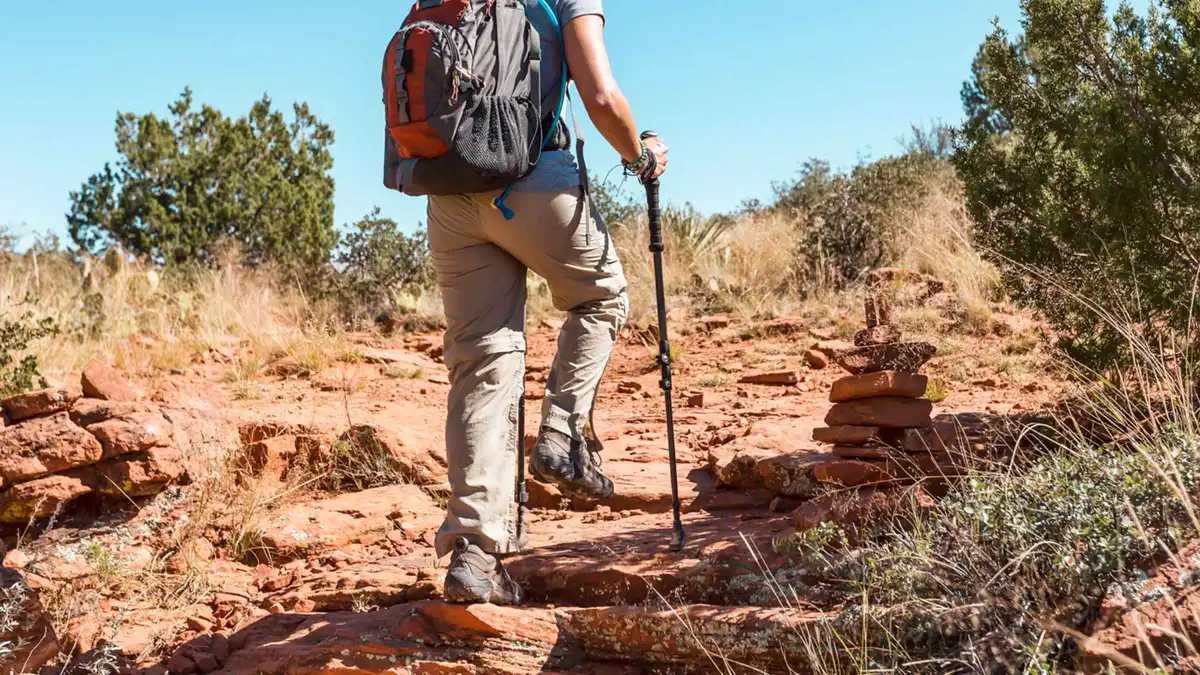 from $123.86
From Sedona: Archeology and Nature Hike
A Jeep ride to a private access point followed by a short, flat 2-mile hike to Native American ruins, positioned as an easier alternative to Palatki or Honanki. The same Sinagua-era dwelling style can be seen without a guide at Palatki Heritage Site, which requires a Red Rock Pass plus a free Recreation.gov reservation.
Check AvailabilityPrices, ratings and details are the platform's own, checked in Q3 2026; dollar figures are the listed prices — the platform bills in your account's currency.
Who built Montezuma Castle, and why the name is wrong
The dwelling is named for an Aztec emperor who had nothing to do with it. European-American settlers in the 1860s assumed the ruin was Aztec; the Southern Sinagua people who actually built it had left more than 40 years before Montezuma was even born.
The Southern Sinagua, 1125 to about 1425
The Southern Sinagua built Montezuma Castle into a limestone alcove roughly 90 feet up a cliff face above Beaver Creek, starting around 1125 CE. The dwelling that survives is five stories and at least 20 rooms, home to perhaps 30 people at its fullest. A second, larger dwelling nearby (Castle A, 45 to 50 rooms, excavated in 1933) has mostly collapsed and is not part of the visitor route.
Together the two structures anchored a riparian settlement along Beaver Creek that the Sinagua occupied for more than 400 years before moving on, part of the same regional dispersal that also emptied Tuzigoot by the 1300s.
- Built into the cliff starting around 1125 CE
- Five stories, at least 20 rooms, roughly 30 residents at capacity
- Castle A nearby held 45-50 rooms, excavated 1933, largely collapsed today
Named after the wrong empire
European-American settlers who found the dwelling in the 1860s assumed it was built by the Aztec, and the name stuck. It's wrong on every count: the Sinagua were not Aztec, and the dwelling itself was already depopulated for roughly four decades before the historical Montezuma was born. The Park Service's own page on the site does not spend space correcting the name; the fuller explanation, cross-checked against the historical record, comes from the secondary literature on the monument's naming.
What the name gets right by accident is scale. From below, five stories cut into a cliff face does look like a fortified keep, which is presumably why the description survived a century and a half of better information.
What you actually see from the paved loop
The interior hasn't been open to visitors since 1951, so the visit is a viewing experience, not a walk-through. And that changes how much time to plan for.
No entry since 1951
Early visitors climbed ladders into the dwelling; the Park Service ended that access in 1951 over structural damage and safety concerns after decades of foot traffic and looting had already stripped most original artifacts from the site. What remains is one of the best-preserved cliff dwellings in North America precisely because it has been left alone since. The one-third-mile paved, largely flat loop trail is the entire visitor route: it runs along the base of the cliff at a comfortable viewing distance, past interpretive signs, with the best photo angle roughly two-thirds of the way along where the five stories read clearly against the rock.
The visitor center and museum
The visitor center sits at the trailhead and holds a small museum on Sinagua life along Beaver Creek, pottery, tools, and the archaeology of the 1933 Castle A excavation. It's a five-minute stop, useful context before or after the loop rather than a destination on its own.
Montezuma Well: the free, separate unit five miles north
Montezuma Well is administratively part of the same national monument but sits about 20 minutes' drive away, near Rimrock, a detached unit with its own entrance, its own trail, and no fee at all, not even a shared ticket requirement with the Castle. It's a natural limestone sinkhole roughly 100 by 120 yards across, fed by a constant spring, with its own small Sinagua dwellings built into the rim and a short trail down to an original irrigation ditch the Sinagua dug to carry water out to fields below. The federal government bought the Well in 1947 to protect it as part of the monument.
To get there from the Castle: I-17 north to Exit 293 (4 miles north of the Castle's own Exit 289), then follow the signed local roads through McGuireville and Rimrock for about 4 more miles. The Park Service specifically warns that GPS apps sometimes route drivers onto unpaved backcountry Forest Service roads to reach the Well. Stay on the paved route through Rimrock instead, particularly in anything but a high-clearance vehicle.
- No fee, no shared-ticket requirement with the Castle
- About 20 minutes' drive from the main unit, via I-17 Exit 293
- Its own Sinagua dwellings in the rim, plus a short walk to an original irrigation ditch
- Stay on paved roads through Rimrock; some GPS apps misroute onto rough Forest Service roads
Hours and when it's quiet
The park, visitor center and trails are open all seven days, 8:00 am to 5:00 pm; the Montezuma Well picnic area keeps slightly shorter hours, 8:00 am to 4:00 pm. Both close early, at 2:00 pm, on Thanksgiving and Christmas Eve, and the whole monument is closed on Christmas Day and New Year's Day.
The Park Service does not publish a busiest-hour or busiest-season figure for Montezuma Castle the way some larger parks do. Given the size of the lot and the short loop, the working assumption worth planning around is the same one that applies to any small, free-flowing NPS stop just off a major interstate exit: arrive before 10:00 am or after 3:00 pm for a quieter visit, and expect the lot to fill on spring and holiday weekends when Camp Verde traffic off I-17 is heaviest.
Getting here from Sedona
No NPS or Arizona DOT page publishes a single Sedona-to-Montezuma-Castle mileage or drive time, both agencies describe their own end of the route and stop there. Chaining the two together: from Sedona, take SR-179 south to its southern terminus at I-17 Exit 298 (about 15 miles north of Camp Verde, per ADOT), then continue south on I-17 to Exit 289, the monument's own exit, which the Park Service itself describes as "45 minutes south of Flagstaff." Budget roughly 45 to 55 minutes of straightforward interstate driving for the Sedona leg. That figure is our estimate from the road numbers, not a published agency time, so build in slack rather than timing a reservation around it (the entry itself needs no reservation, which helps).
From the interstate exit, a short local road leads directly to the visitor center at 2800 Montezuma Castle Hwy, Camp Verde. The route passes within a few minutes of Verde Canyon Railroad in Clarkdale and Tuzigoot, which makes a same-day pairing with either straightforward. See the timing options in the routing table below.
How much time to give Montezuma Castle
The Park Service doesn't publish a suggested visit length. These three routings are ours, built around the fact that the interior is closed and the whole visitor experience is a short paved loop plus a museum stop.
The variable that actually changes your day is not the Castle. It's whether you also drive the extra 20 minutes to Montezuma Well and whether you're pairing the stop with Tuzigoot, which the same ticket already covers.
| Routing | What you get | What it skips | Door to door |
|---|---|---|---|
| Castle only | The paved loop trail and the visitor center museum | Montezuma Well and Tuzigoot | 30-45 minutes |
| Castle plus Well | The loop, the museum, and the free detached sinkhole unit with its own Sinagua dwellings and irrigation ditch | Tuzigoot | About 1.5 hours including the drive between units |
| Castle plus Tuzigoot | Both monuments on the one $10 ticket, plus the option to add Clarkdale's Verde Canyon Railroad or Jerome the same day | Nothing, but it's a full half-day out of Sedona | 3-4 hours including driving between all three stops |
Montezuma Castle In Seven Dates
Every date below is already argued somewhere on this page; the list is here so the place reads in order.
-
About 1125 CE
Construction begins
The Southern Sinagua start building into the limestone alcove above Beaver Creek.
-
Through the 1300s
Riparian community along Beaver Creek
The dwelling and the nearby, larger Castle A structure anchor a settlement occupied for more than 400 years in total.
-
By about 1425
The Sinagua move on
The dwelling is depopulated, part of the same regional dispersal that also empties Tuzigoot.
-
1860s
European-American settlers misname it
Assuming an Aztec connection that never existed, settlers attach the name "Montezuma Castle". Decades after the dwelling had already been depopulated for longer than Montezuma had been alive.
-
8 December 1906
Declared a National Monument
President Theodore Roosevelt designates it one of America's first national monuments, citing "the greatest ethnological value and scientific interest."
-
1933
Castle A excavated
The larger, 45-50 room structure near the main dwelling is excavated, by which time intensive looting has already stripped most original artifacts from the site.
-
1947
Montezuma Well added to the monument
The federal government purchases the detached sinkhole unit 20 minutes north to protect its own Sinagua dwellings and spring.
-
1951
Interior access ends
The Park Service stops allowing visitors to climb into the dwelling, citing structural damage and safety; the paved loop trail becomes the entire visitor route, unchanged since.
Dates as recorded on nps.gov/moca and cross-checked against the monument's Wikipedia history, read for this guide in Q3 2026.
At Montezuma Castle: What To Do, And What Not To
Every line here is a decision argued somewhere above, compressed into the form you can act on at the gate.
Do
- Buy the $10 ticket even if you're only planning the Castle today. It's good for 7 days and covers Tuzigoot too
- Drive the extra 20 minutes to Montezuma Well if you have it. It's free and shows a different side of the same Sinagua culture
- Arrive before 10:00 am if a quiet loop matters more than a late start; the lot is small
- Stay on paved roads through Rimrock for Montezuma Well, some GPS apps route onto rough Forest Service roads
- Pair the stop with Tuzigoot or Clarkdale's Verde Canyon Railroad the same day; all three sit within a short drive of each other off I-17
Don't
- Don't expect to go inside. The dwelling has been closed to entry since 1951; there is nothing to unlock or arrange
- Don't book a guided tour expecting it to enter the monument. None does; the jeep and hiking trips sold near Sedona visit different, privately accessible ruins
- Don't assume the name means anything, it's a 19th-century misattribution to the Aztec emperor, unconnected to the Sinagua who actually built it
- Don't plan a Christmas Day or New Year's Day visit. Both the Castle and the Well units are closed
- Don't skip the visitor center expecting nothing there. The small museum on Castle A's 1933 excavation is worth the five minutes
Five Things Most Visitors Do Not Know About Montezuma Castle
All five change something practical or correct something widely repeated about the visit.
- The name is a double mistake. Not Aztec, and not a castle. The Sinagua who built it had left the site roughly four decades before the historical Montezuma was even born [NPS history page; Wikipedia's cross-checked account of the 1860s naming, read in Q3 2026]. - A 1952 Western was shot on location here. Flaming Feather used the dwelling as a climax location, back when far more casual visitor access was still possible [Wikipedia, In Popular Culture section, read in Q3 2026]. - Montezuma Well costs nothing and needs no ticket at all. It isn't bundled with the Castle fee because it doesn't charge one in the first place, a genuine rarity among Park Service units [nps.gov/moca fees page, read in Q3 2026]. - One ticket, two monuments, a full week. The $10 adult fee is a 7-day pass valid at both Montezuma Castle and Tuzigoot, 20 minutes apart.
Most visitors buying at one gate don't realize the ticket already covers the other [nps.gov/moca fees page]. - No operator runs tours inside either monument. The jeep and hiking trips marketed around Sedona's Sinagua ruins visit different, privately accessible sites. There is no paid tour product that actually enters Montezuma Castle or Tuzigoot, because neither is set up to host one [tours.json listings cross-checked against nps.gov, read in Q3 2026].
Montezuma Castle map: the two units and the drive from I-17
The main visitor center at Exit 289, Montezuma Well 4 miles up the interstate at Exit 293, and the nearest other day-trip stops.
Next stop from Montezuma Castle
Drive minutes are our estimates chained from agency-published road fragments, not a single official figure.
Montezuma Well
The free, detached unit of the same monument, 4 miles north on I-17 at Exit 293. What you'll find there.
20 min driveTuzigoot National Monument
The same $10 ticket already covers it. Tuzigoot's hilltop pueblo is a taller, denser Sinagua site above the Verde River.
About 20 min driveVerde Canyon Railroad
A 4-hour scenic rail trip from Clarkdale, right next to Tuzigoot. Verde Canyon Railroad guide.
About 25 min driveMontezuma Castle questions
Is Montezuma Castle worth a visit?
Yes, if you set expectations correctly: it's a short paved loop and a small museum, not a walk-through ruin, since the interior closed in 1951. As a 30-45 minute stop off I-17, on a ticket that also covers Tuzigoot for a week, it's an easy, low-cost addition to a Verde Valley day rather than a destination to build a whole day around on its own.
Can you go inside Montezuma Castle?
No. The Park Service closed the dwelling to entry in 1951 over structural damage and safety concerns. You view it from the paved loop trail at the base of the cliff. If you want to walk beside a Sinagua-built structure, the short trail at Montezuma Well gets you closer to an original irrigation ditch, though not into a dwelling either.
How much does it cost to get into Montezuma Castle?
$10 per adult (16 and older), a 7-day pass valid at both Montezuma Castle and Tuzigoot; under-16 is free. Montezuma Well, the detached unit 20 minutes north, costs nothing at all. The full breakdown of every pass option is in the tickets table above.
What movie was filmed at Montezuma Castle?
The 1952 Western Flaming Feather used the dwelling as a location for its climax, filmed back when visitor access was considerably more casual than the closed-off, look-only visit of today.
Is Montezuma Well included in the Montezuma Castle ticket?
It doesn't need to be. Montezuma Well charges no fee at all, ticket or otherwise. It's a separate, detached unit of the same monument about 20 minutes' drive north, reached via I-17 Exit 293 and signed local roads through Rimrock.
How do I get to Montezuma Castle from Sedona?
SR-179 south from Sedona to I-17 Exit 298, then south on I-17 to Exit 289, the monument's own exit. No agency publishes a single Sedona-to-monument time; budget roughly 45-55 minutes of highway driving as our estimate. The route passes close to Tuzigoot and Verde Canyon Railroad in Clarkdale if you're combining stops. See the full day trips list.
Montezuma Castle On Film: What The Cliff Dwelling Actually Looks Like
Three walkthroughs that show the paved loop, the cliff face and what the visit is actually like, useful before you decide how much time to give it.
How to Visit Both Montezuma Castle And Montezuma Well, Arizona
A practical walkthrough of both units on the same trip, including the drive between them.
Video: Live That AdventureMontezuma Castle: What to expect
A short, honest preview of the paved loop and what there is (and isn't) to see up close.
Video: SeniorSoloTravelSedona Travel Guide | MONTEZUMA CASTLE & TUZIGOOT
Both monuments covered together on the shared 7-day ticket, filmed on the same trip.
Video: Eat Trade TravelVideos load from YouTube only when you press play.
Reviewed Q3 2026 (July–September 2026); next review Q4 2026. Prices, hours and terms are set by the venue or operator and confirmed at checkout.
We may earn a commission if you book through one of our links, at no extra cost to you. Full affiliate disclosure